


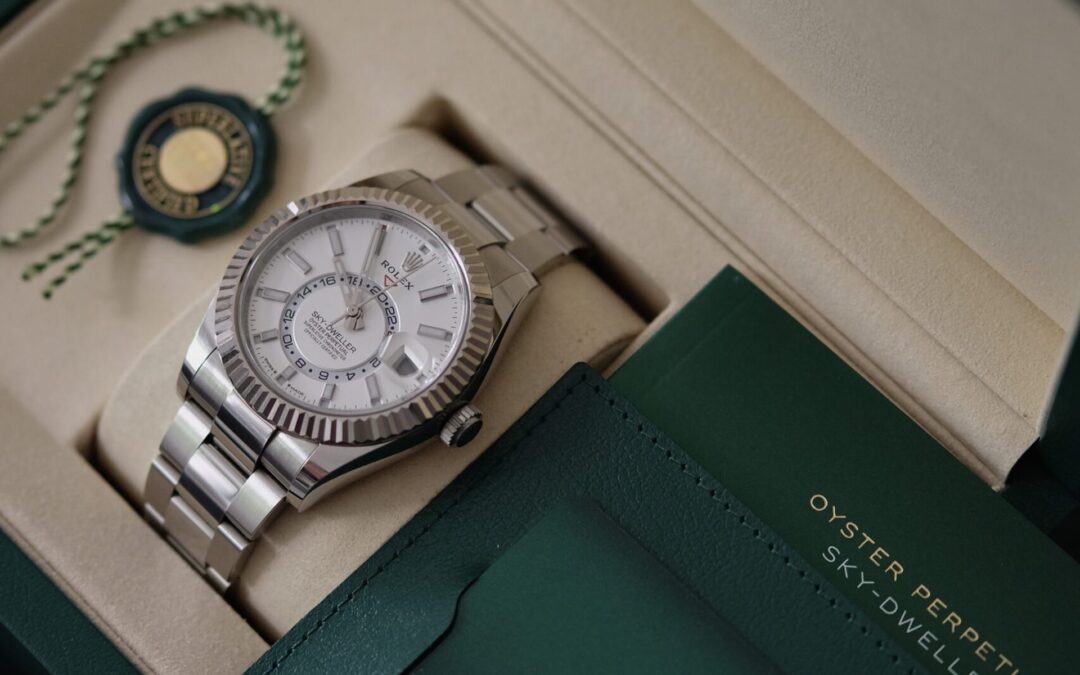
The Ring Command bezel is the moment this watch divides opinion. Show it to someone who has never seen it explained and they assume it is decorative, same as the fluted bezel has been on every other Rolex since the 1950s. Show it to someone who understands what it does and they tend not to go back to thinking of it as decoration. That gap in understanding is why the Rolex Sky-Dweller review conversation usually starts in the wrong place, with price, rather than with the two problems this watch was actually designed to solve.
The Problem With Date Watches
Every watch with a standard date display requires manual correction six times per year. February ends. April ends. June ends. September ends. November ends. And the date display, oblivious, rolls to the 31st of a month that only has 30. Six times a year you reach for the crown and advance it manually. For most watches, that is an accepted inconvenience. For a watch positioned at the top of the Rolex catalogue, Rolex decided it was not acceptable.
The Saros annual calendar fixes this. It automatically distinguishes 30-day from 31-day months throughout the year. February is still the exception. On 1st March, one manual correction. One. For the rest of the year the calendar is accurate without touching it. The mechanism behind it is deliberately simple: four additional gear wheels, two gear ratios, added to the standard Rolex instantaneous date system. Rolex named it after an 18-year astronomical cycle for reasons that are more poetic than technical, but the mechanism is the achievement, not the name.
The Ring Command System Is Not as Complicated as It Sounds
Three notch positions on the bezel. First: date and month setting. Second: local time. Third: reference time. Rotate counterclockwise to select, use the crown to adjust. Each function is completely isolated, which matters on a watch this complicated because the risk of accidentally adjusting the wrong thing is real on competitor pieces that do everything through the crown alone.
The bezel being functional rather than decorative is the detail that rewards understanding. Rolex introduced the fluted bezel as a screw-on design in the 1950s. By the time the Sky-Dweller arrived in 2012, the fluted bezel had been standard on the Datejust and Day-Date for decades. It had never done anything mechanical. The Sky-Dweller took that established design element and gave it an actual job for the first time in sixty years.
Dual Timezone Without Arithmetic
The off-centre 24-hour disc is understated in how well it works. Most dual-timezone implementations require the wearer to mentally convert between a 12-hour display and a 24-hour reference to understand whether the second timezone is showing morning or afternoon. The Sky-Dweller removes that step. A fixed red triangle points continuously to reference time on the 24-hour disc. The answer to “what time is it at home” does not require any arithmetic. It is just there.
Compared to the GMT-Master II’s approach, which uses a 24-hour graduated bezel and a separate GMT hand, the Sky-Dweller is quieter about the whole thing. The GMT hand on a GMT-Master II is hard to miss. The 24-hour disc on a Sky-Dweller is easy to overlook until you know what you are looking for, which is either a design flaw or an elegant restraint depending on your preferences. The practical outcome, knowing what time it is in two places simultaneously, is identical. The visual approach is not.
Calibre 9002 and Why the 2023 Update Matters
Eleven years between updates. That is how long the original Sky-Dweller calibre 9001 ran before Rolex replaced it with the 9002 in 2023. The 9002 carries the Chronergy escapement, developed in nickel-phosphorus for efficiency and magnetic resistance. Blue Parachrom hairspring. Power reserve extended to 72 hours, up from 70 on the 9001. Precision at minus two to plus two seconds per day after casing, which is the Superlative Chronometer standard Rolex applies across the current range.
Practically: leave it on the bedside table Friday night. Still running accurately Monday morning. That is the 72-hour reserve in a real scenario rather than a specification table.
The 2023 update also introduced four new dials for the 336934 Oystersteel reference: black, white, bright blue, and mint green. The mint green was the one that immediately attracted secondary market interest, currently trading at a premium over the other variants. Reference 336933 is the yellow Rolesor two-tone. Reference 336935 is Everose gold throughout with a blue-green dial that does not appear on any steel variant. All three run at 42mm, water resistant to 100 metres, on either the Oyster bracelet or Oysterflex rubber strap.
The Sky-Dweller without the AD waiting list. Our Rolex Sky-Dweller competition has limited entries, weekly bonus draws, and a guaranteed winner drawn live. Entry costs considerably less than a pre-owned 336934.
The Honest Case Against It
42mm is not a sports watch size and not quite a dress watch size. It is a confident size for a watch with confident pricing. On smaller wrists it reads large. On larger wrists it sits well. This is not something you discover from a review. It is something you discover from trying one on, which is what you should do before spending this kind of money on any watch regardless of what a review says.
The price sits at the top of the Rolex catalogue for steel references. That premium over the Submariner or GMT-Master II is earned by the movement complexity, not by the case or the bracelet. If you do not care about the Saros calendar or the dual timezone function, a Submariner Date gives you a better-recognised watch at a lower price. The Sky-Dweller makes sense specifically for someone who wants those complications and wants them from Rolex. For more detail on what each reference actually costs in the UK, see our Rolex Sky-Dweller price guide.
Is the Rolex Sky-Dweller worth the premium over other Rolex models?
If you want the complications: yes. The Saros annual calendar and Ring Command dual timezone are not available anywhere else in the Rolex catalogue. The engineering behind both is genuine, patented, and not replicated by other watchmakers in the same configuration. If you are comparing by recognition value alone, a Submariner or Datejust will be more immediately identified as a Rolex by people who do not know watches. The Sky-Dweller earns its premium on what it does mechanically. Whether that matters to you is the honest question to answer before the purchase rather than after. Browse the full competitions at The Time Vault Club for other watches in the range.
Which is better for travel, the Rolex Sky-Dweller or the GMT-Master II?
The GMT-Master II is more immediately readable in transit. The 24-hour bezel colour coding gives you home time at a glance without needing to focus on a disc. The Sky-Dweller’s dual timezone is more integrated and arguably more elegant, but it requires familiarity before it becomes faster to read than the GMT-Master II’s approach. For frequent travellers who care primarily about timezone legibility, the GMT-Master II is the cleaner tool. For travellers who also want the annual calendar in the same watch and can live with 42mm on the wrist, the Sky-Dweller is the only option Rolex makes.