


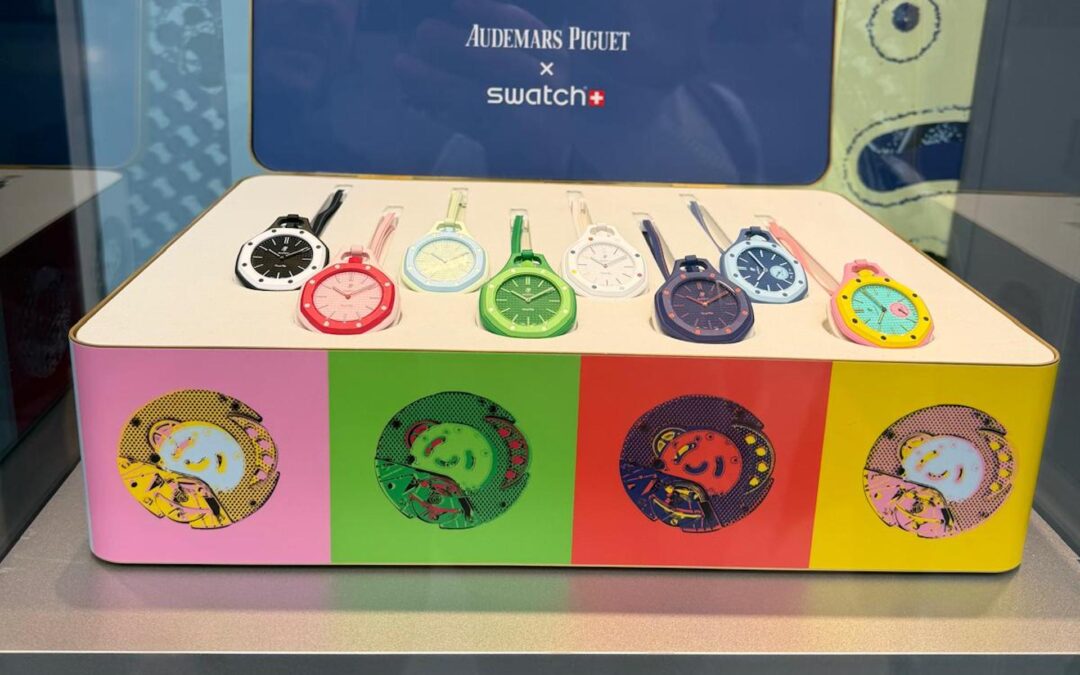
Most people looked at the Royal Pop and saw a pocket watch. A few people looked at it and saw a legal strategy.
What happened outside Swatch stores on 16 May 2026 looked, from the outside, identical to what happened with the MoonSwatch in 2022. People had slept on pavements. Units were showing up on eBay before lunchtime at three or four times their £350 retail price. The queue, the chaos, the secondary market feeding frenzy. Same story, different drop. What got less coverage was why AP agreed to any of it, and that story is considerably more interesting.
Did AP Actually Lose Trademark Cases Before the Royal Pop?
Yes. Twice, in two different jurisdictions.
The first loss came in Japan. In 2020, AP filed an application with the Japan Patent Office to trademark the Royal Oak’s design. The filing cited the octagonal bezel, eight hexagonal screws, tapisserie dial, and the integrated bracelet that Gerald Genta sketched on a napkin in 1972, when AP needed a steel sports watch ready for Basel in under 24 hours. The JPO turned it down in 2021. The design was not distinctive enough, it ruled. Consumers would look at the shape and see a wristwatch, not a specific brand. AP filed an appeal. The JPO read it and came to the same conclusion in June 2023. AP escalated to the IP High Court. In March 2024, it lost there too, with the court holding that even if the Royal Oak was “unique as a whole,” each individual component fell within the range of expected functional choices for a watch.
Eighteen months later, the US came to a similar conclusion. On 2 January 2025, the Trademark Trial and Appeal Board upheld the USPTO’s refusal to register AP’s applications for the Royal Oak’s three-dimensional configuration. Two applications. Two rejections. The board examined the watch face, bezel, casing, and bracelet together and found grounds to refuse on both functionality and a lack of acquired distinctiveness. The board’s sharpest finding concerned AP’s advertising evidence: years of marketing materials had paired the word marks “AP” and “Audemars Piguet” with the design so consistently that the design never had to carry the brand recognition alone.
That finding matters a great deal. The courts were not saying the Royal Oak is unrecognisable. They were saying AP had not built sufficient legal evidence that consumers attribute the octagonal bezel to AP specifically, rather than to luxury watches in general. That is precisely the gap the Royal Pop is designed to close.
What Does the MoonSwatch Have to Do With This?
More than most people have noted.
The MoonSwatch dropped in March 2022 and neither Omega nor Swatch had seen anything quite like the response. Overnight queues in cities where people do not generally sleep outside watch shops. The $250 bioceramic Speedmaster went on to sell a million units. In the months after the launch, sales of the original Speedmaster Moonwatch at Omega boutiques climbed by over 50%, a number confirmed publicly by Swatch Group CEO Nick Hayek. The Moonwatch, for context, retails at around $7,000. Cheaper did not mean diminished.
That number is the commercial foundation of the ap swatch collab. The MoonSwatch settled an argument the watch industry had been having for years. Making a cheaper version of an icon does not wreck the original. It brought in buyers who had never walked into an Omega boutique, and based on those Speedmaster sales figures, a significant proportion of them came back to do exactly that. The halo effect was not a theory after 2022. It became evidence.
AP sat outside Swatch Group watching that unfold. The Royal Pop is the direct result.
Why Does Brand Dilution Miss the Point?
The most predictable reaction to the swatch x ap collab from collectors who have spent serious money on a Royal Oak is that the octagonal bezel now belongs, in some sense, to a pocket watch available for £350 in a shopping centre. That frustration is understandable. It is also backward.
AP’s problem, as established in two courtrooms, is not that its design is too common. It is that the legal evidence of its distinctiveness was not strong enough. Recognition in the trade press is not the same thing as trademark protection. The legal standard requires evidence that ordinary consumers associate the shape specifically with one brand, and that evidence has to survive cross-examination in a courtroom. AP had plenty of the former. The TTAB ruled the latter was what was missing.
The Royal Pop generates that evidence at a scale no advertising budget could match. Every queue outside a Swatch store is photographed and published. Every resale listing connects that octagonal shape to the Audemars Piguet name explicitly. Every social post does the same work. The collaboration does not dilute the Royal Oak. It frames the design language as AP’s in a way that 50 years of watches and brand campaigns apparently did not fully achieve on the legal standard that courts require.
“By attaching the Audemars Piguet name directly to the octagonal bezel across 200 Swatch stores, millions of social media posts, and a global resale frenzy, the Royal Pop builds the very consumer association between design and brand that the courts said was absent from AP’s trademark evidence.” — Lexology analysis, 2026
Is the Royal Pop Building Evidence for Future Trademark Claims?
That is the argument gaining traction in IP and watch industry circles, and it is a credible one.
The Royal Pop does not immediately restore the trademark registrations AP lost. Trademark law does not move that quickly. But it changes the landscape for any future application or infringement action. Before 16 May 2026, AP’s evidence was largely industry coverage and auction records, paired with marketing materials that had never let the design stand alone without the word marks alongside it. After the launch, the picture is different. Millions of consumers queued for a product where the octagonal case and the Audemars Piguet name sit together on the dial, with no supporting text required. That is a materially different kind of evidence.
AP licensed the design deliberately to Swatch, a brand entirely outside its own group, for the first time in Swatch’s history of luxury collaborations. The commercial terms included a commitment from AP to direct 100% of its proceeds to watchmaking heritage preservation. The charitable framing is smart PR. The IP framing is better strategy.
What Does This Mean for Anyone Who Already Owns a Royal Oak?
Less than the internet would have you believe.
The Royal Pop is a pocket watch. It does not have a movement that competes with the Royal Oak Calibre 3120. It does not sit on a wrist. The design language is shared; the object is entirely different. A collector who spent five figures on a Royal Oak Offshore is not having their investment diluted by a bioceramic lanyard piece made for a generation that has never owned a mechanical watch. If anything, the halo effect points the other direction: the Royal Pop introduces the octagonal bezel to an audience that will, eventually, aspire to the real thing.
Should You Try to Get One?
If you want one at retail, the honest answer is that the launch window is gone. The 16 May drop ran on the same boutique-only, one-per-customer model as the MoonSwatch, and units hit the secondary market at several times their CHF 350-375 price within hours of stores opening.
The Time Vault Club runs Swatch watch competitions that give members a far more accessible route to desirable pieces than standing outside a boutique on a weekday morning. For broader watch competitions across brands and references, the same is true.
Whether the Royal Pop is worth chasing at resale depends on what you make of the object itself. Technically it is impressive. The SISTEM51 movement delivers over 90 hours of power reserve, the bioceramic case resists scratching better than steel, and the two case styles give the collection genuine variety. As a piece of design history that also doubles as a calculated response to two courtroom defeats, the swatch x ap collab carries more backstory than almost any limited release in recent memory.
The Royal Pop was never just a pocket watch. It was AP playing a very long game, and most people watching the queues had no idea.